
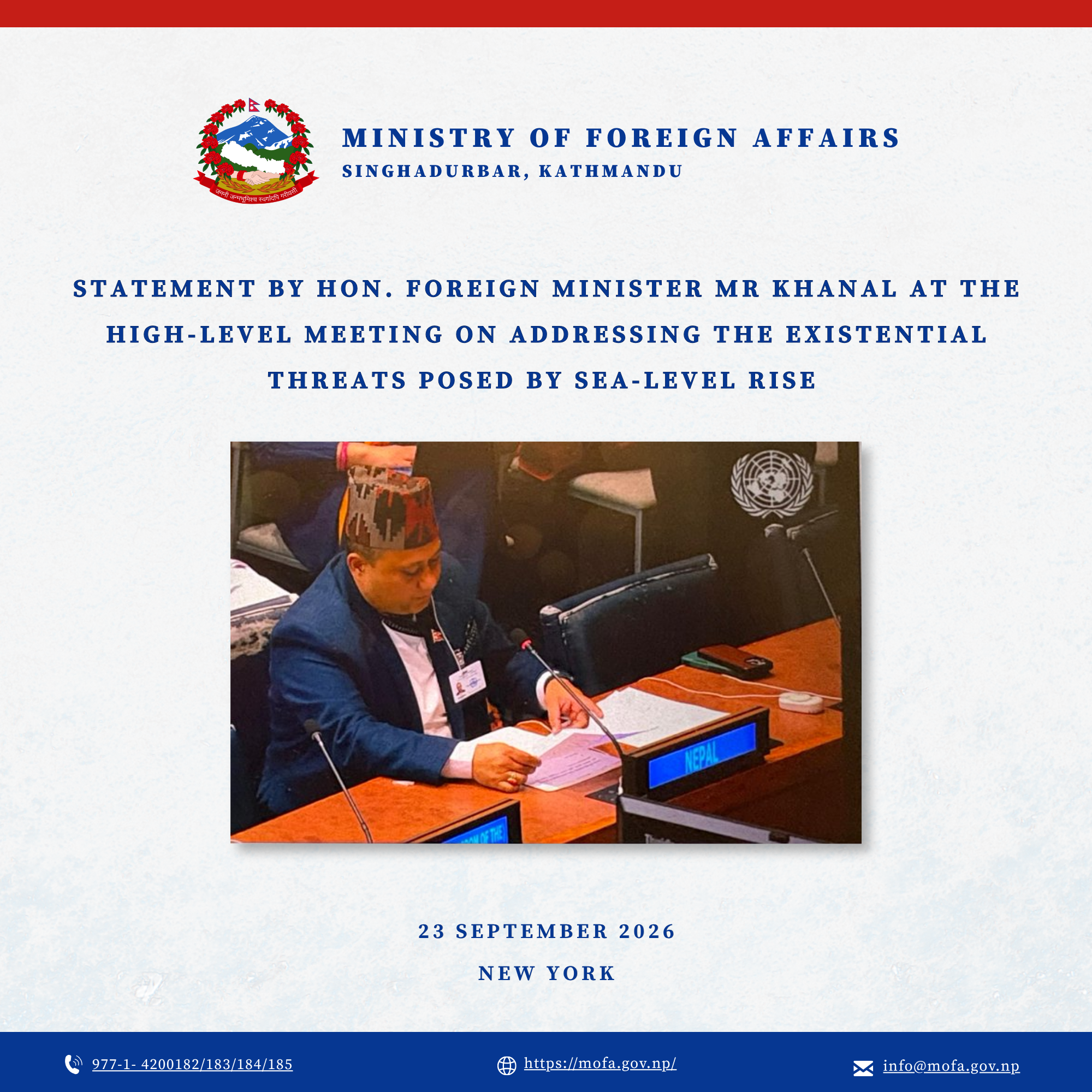
Statement by Hon. Foreign Minister Mr. Shisir Khanal at the High-Level Meeting on Addressing the Existential Threats Posed by Sea-Level Rise
24 September 2026, New York
Statement by Hon. Foreign Minister Mr. Shisir Khanal at the High-Level Meeting
Theme: Addressing the Existential Threats Posed by Sea-Level Rise
Mr. President,
Excellencies.
Our civilization and ancient wisdom remind us that the Himalayas and the seas form a continuous story of creation.
Today, that story is under profound threat.
With vanishing glaciers and rising sea, the wisdom of our ancestors calls upon us to protect this fragile balance with urgency and unity.
Mountainous countries and island states, which contribute least to global emissions, stand as the most acute victims of the global climate crisis.
This is unjust.
This is our moral failure.
This is the failure of our solidarity.
This is also a stark reminder that climate change is not only an environmental challenge but a question of equity, justice, and shared responsibility.
The devastating climate‑induced flash floods that struck Nepal last month demonstrated how cryospheric risks can cascade through rivers and watersheds, destroying lives, livelihoods, and critical infrastructure.
This is why we need a stronger collective action to support the countries on frontline of the climate crises.
Mr. President,
Against this backdrop, let me highlight few points:
First, we must adopt an integrated approach to addressing climate impacts from the highest mountain on Earth to the deepest depths of the ocean. Nepal is advancing this vision through its ‘Sagarmatha to the Sea’ initiative.
Second, we must double down on efforts to keep the 1.5°C goal within reach. This is a matter of survival for mountainous and coastal communities.
Third, climate finance must reach the frontlines, particularly vulnerable mountain and coastal communities, through resources that are accessible, affordable, predictable and increasingly grant-based. This is not a charity but climate justice. Wealthy nations must lead from the front to support vulnerable countries.
Fourth, we must significantly expand investment, accelerate technology transfer, and strengthen capacity‑building support for adaptation and resilience.
We must scale up multi‑hazard early‑warning systems and climate‑resilient infrastructure, ensuring that vulnerable communities, whether in the high mountains or on low‑lying coasts, are protected.
To conclude, Mr. President,
The retreat of glaciers and rise of seas are testing the very foundations of multilateralism.
Our response must demonstrate that the United Nations can rise to meet the moment.
Let us act with urgency, unity, and foresight to protect our shared planet and secure a livable future for generations to come.
Thank you.


_MlbfVEdgFl_oaux7lg_YvvZnZKhlK_pq8f8ny.png.370x245_q70_crop.jpg
)