

Welcome remarks by Hon. Minister for Foreign Affairs Mr Shisir Khanal at the event "Sagarmatha to the Sea: A Call to Action for a Climate-Resilient Future" at UNHQs in New York
UNHQ, 25 September 2026
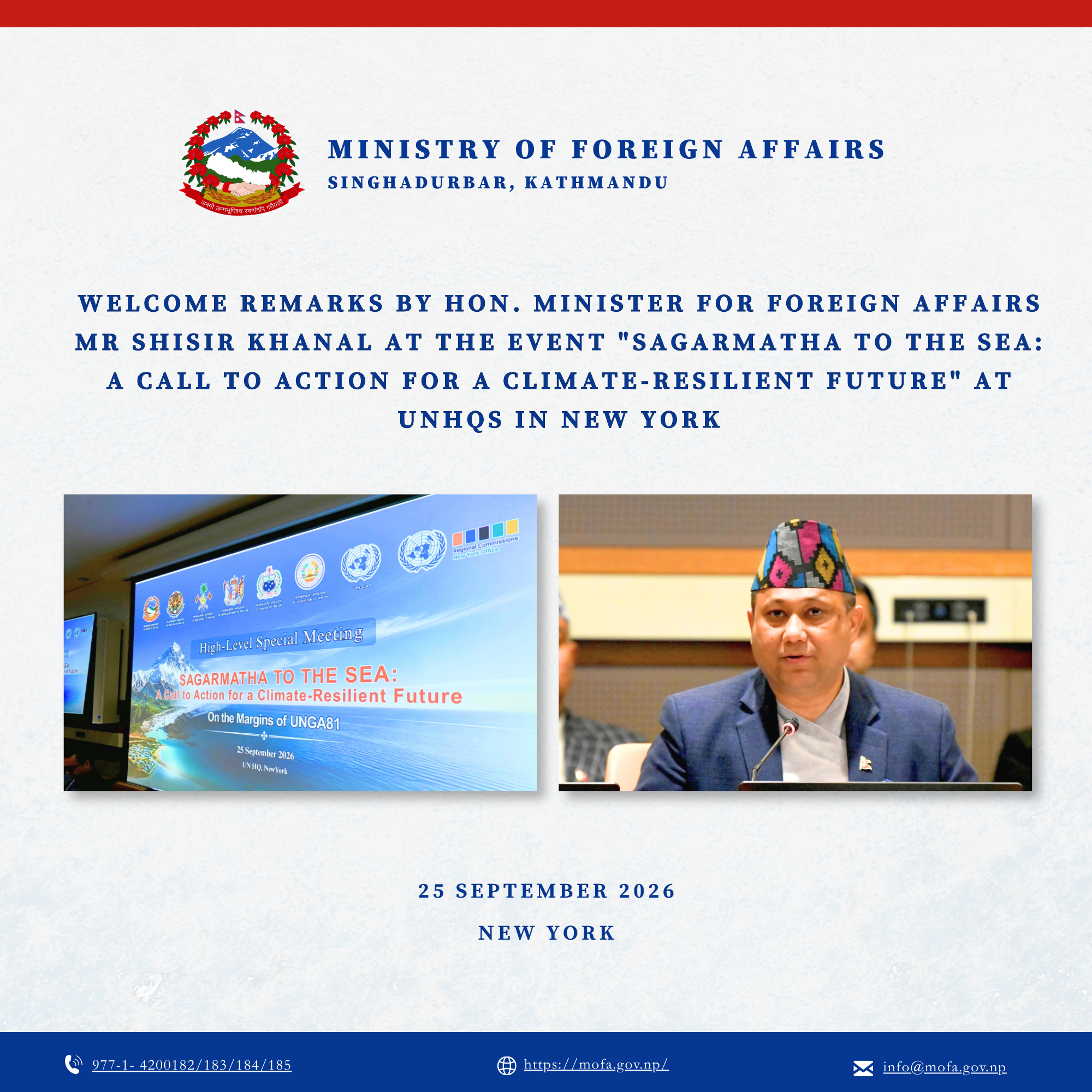
Welcome remarks by Hon. Minister for Foreign Affairs Mr Shisir Khanal at the event "Sagarmatha to the Sea: A Call to Action for a Climate-Resilient Future" at UNHQs in New York
Mr. President of the General Assembly,
Honourable Ministers and Representatives of our co-hosting countries,
Executive Director of UNEP,
Executive Secretary of ESCAP,
Excellencies,
Distinguished colleagues,
Ladies and Gentlemen,
Namaste and good afternoon.
On behalf of the Government and people of Nepal, it is my privilege to welcome you to this High-Level Special Event, “Sagarmatha to the Sea: A Call to Action for a Climate-Resilient Future.”
I extend my sincere appreciation to all our partners - Bhutan, Maldives, New Zealand, Samoa and Tajikistan - and UN agencies, together with UNEP and ESCAP.
Your partnership brings mountain, island and coastal perspectives into one conversation.
We gather at a difficult moment for Nepal. On 26 August, a massive collapse of rock and glacier ice in the Langtang region triggered what I have described as a “Himalayan Tsunami,” taking lives and destroying homes and vital infrastructure.
The wounds are still fresh. There could hardly be a more timely moment for this conversation.
Excellencies,
Sagarmatha to the Sea begins with a simple proposition: the climate system does not recognize the boundaries through which we organize our politics.
Sagarmatha, the tallest mountain on Earth, commonly known as Everest, and the Himalayan region called the - third pole contains the largest volume of snow and ice outside of the polar regions, featuring an inventory of over 63,700 glaciers. Standing at the foot of Himalayas, in 2023, Secretary-General Antonio Guterres described these glaciers as “icy reservoirs.”
From there, water descends through glaciers and rivers, nourishing ecosystems and communities before reaching the sea.
But, Nepal has lost close to one-third of its ice in the last three decades.
Their decline alters river flows and threatens livelihoods downstream, while island and coastal nations confront rising seas, erosion and displacement.
Excellencies,
Allow me, therefore, to offer five propositions.
First, science, policy and investment must recognize the ecological continuum connecting mountains, freshwater systems and oceans.
Second, mountains deserve greater prominence in climate processes, including systematic integration across relevant UNFCCC frameworks.
Third, keeping 1.5°C within reach is imperative. Every fraction of a degree matters, requiring accelerated emission reductions and implementation of the transition away from fossil fuels agreed under the UNFCCC process.
Fourth, preparedness requires stronger early-warning systems, resilient infrastructure, anticipatory action and scientific cooperation.
Fifth, developing countries need adequate, predictable and accessible climate finance, technology and capacity-building. The Fund for responding to Loss and Damage must be sufficiently capitalized and accessible.
Climate justice is tangible when responsibility, capacity and vulnerability are reflected in the support countries receive.
Nepal is doing its part. Forests cover around 46 per cent of our territory; clean hydropower and electric mobility are expanding; and community-led conservation remains central to our environmental stewardship.
Excellencies,
In 2025, Nepal convened the first Sagarmatha Sambaad, focused on climate change, mountains and the future of humanity. We look forward to welcoming the international community for its second edition next year.
We similarly envisage Sagarmatha to the Sea as a platform for knowledge, partnership and practical cooperation.
The mountain and the sea may appear far apart on a map, but nature tells us otherwise.
The water that leaves our glaciers continues its journey. So do the consequences of the choices we make today.
Let Sagarmatha to the Sea become a way of understanding our shared planet, and a foundation for working together to protect it.
I thank you.
25 September 2026
New York
_WabsTWx5K6_kgrtwxb_cCi0du6iAq_tliykw9.png.370x245_q70_crop.jpg
)
_awEUPp3er2_gdugyd8_snpuZgnizk_av8tecd.png.370x245_q70_crop.jpg
)