
Statement by Foreign Minister Mr Khanal at the G7 Development Ministers’ Meeting
23 September 2026, New York
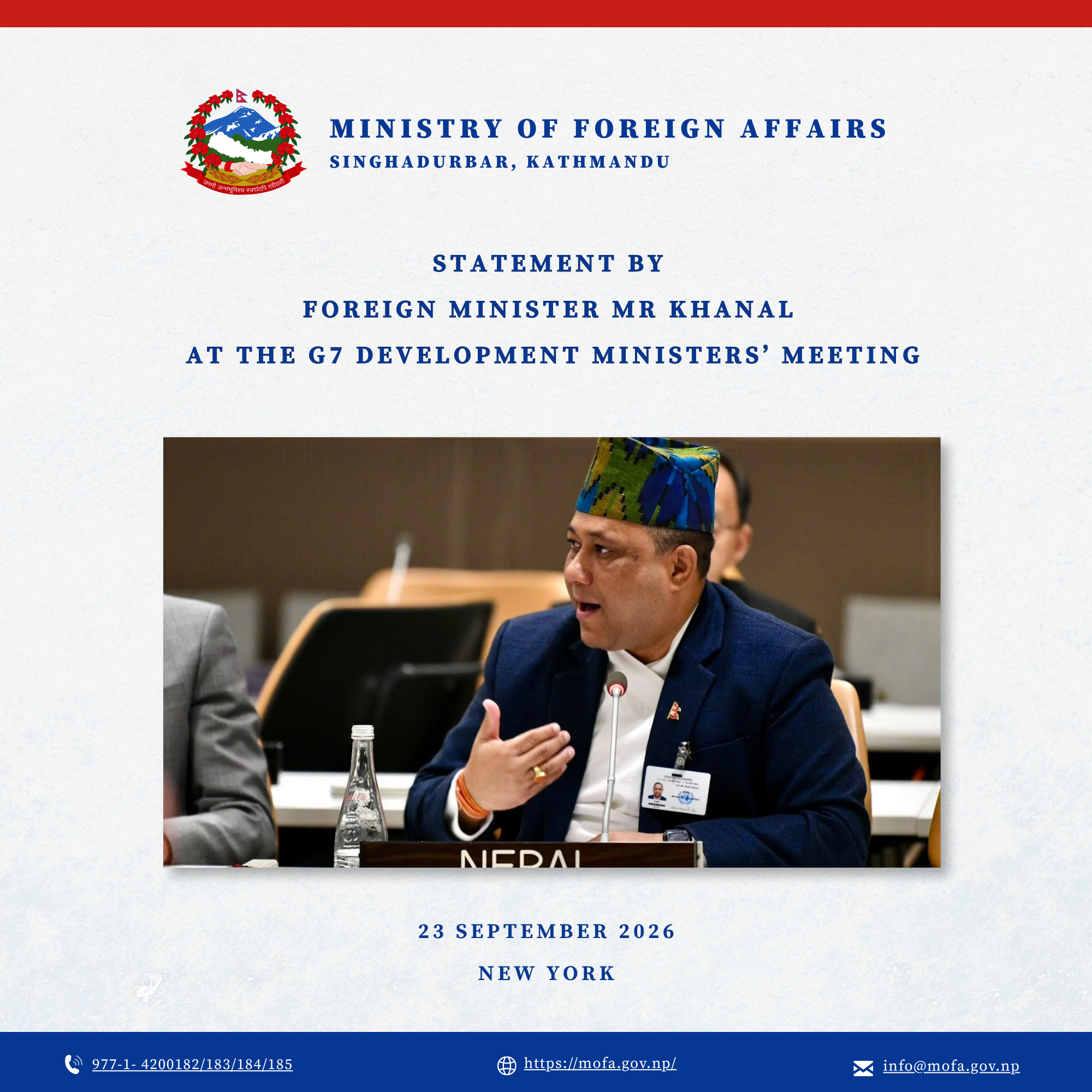
Statement by Foreign Minister Mr Khanal at the G7 Development Ministers’ Meeting
Agenda: Current Affairs and Crisis: Follow-up on the Situation in Nepal
Honourable Ministers,
Excellencies.
I am grateful for the opportunity to be engaged with the G7 members and others on issues of shared global concern.
I thank the French Presidency of the G7 for convening this timely meeting and for dedicating this session to Nepal in the aftermath of the climate catastrophe in Nepal.
On behalf of the people and Government of Nepal, I extend our appreciation for solidarity and support your have been extending to us at these trying times.
Nepal also appreciates the G7’s continued leadership in advancing international cooperation on climate change, sustainable development, resilience, and disaster risk reduction.
We commend the French G7 Presidency for its focus on these critical issues.
These priorities, indeed, resonate strongly with our experience as a mountainous and climate-vulnerable country.
Excellencies,
The magnitude of human loss and devastation caused by the recent climate-induced disaster in Nepal is staggering.
Beyond immense human suffering, the floods have destroyed homes, roads, bridges, schools, health facilities and hydropower infrastructure, disrupting livelihoods and essential services.
Preliminary assessment indicates that over USD 5 billion will be required for recovery and reconstruction.
Scientific assessments are still evolving.
Initial findings point to a complex interaction of ice, rock, water and unstable terrain in a rapidly warming mountain environment.
Our Government has therefore established an expert committee to examine the geological, glacial and hydrological drivers, including the role of climate change.
Excellencies,
From this climate catastrophe as well as numerous other instances in the past, climate change is no longer a distant threat for Nepal.
It is there.
It is real.
It is accelerating- both in frequency and intensity.
It is reshaping our present and constraining our future.
It is costing lives and livelihoods, eroding hard‑earned development gains.
Our mountains, our rivers, our communities and our critical infrastructure are increasingly exposed to floods, landslides, glacial hazards and other climate-induced disasters.
Nepal’s development trajectory, painstakingly advanced over decades, of course, with your longstanding support, is now being slowed, disrupted, and in some cases reversed by climate‑induced disasters.
Your Excellencies know too well, Nepal is a country with a very low contribution to global emissions.
Yet we face disproportionate climate impacts, from catastrophic floods and landslides to melting glaciers and increasingly unpredictable water systems.
Excellencies,
Against this background and in view of the mammoth tasks ahead for recovery and reconstruction, our aspirations at this stage are straightforward.
First, partnership for recovery.
In the aftermath of disasters, we are getting support and immense goodwill from many friendly countries for humanitarian assistance.
But recovery and reconstruction require sustained engagement.
On this, we seek G7 support for a coordinated recovery and reconstruction effort, with grants and concessional financing to rebuild our infrastructure, communities and livelihoods stronger and more climate-resilient.
Second, access to climate finance.
Adaptation and Loss and Damage finance must be faster, simpler and more accessible to countries on the frontlines of climate change.
We have already sent a request to FRLD and waiting for its positive response.
Third, investment in prevention.
Prevention and preparedness must remain at the centre of our collective response.
Investment in early-warning systems, climate information, hydrometeorological services, climate-resilient infrastructure, and community-based disaster preparedness is urgent.
We call upon our partners to scale up such investments and help us against the growing severity of climate‑induced disasters.
Fourth, stronger multilateral action.
Mobilizing rapid, affordable and accessible financing from multilateral development banks and international financial institutions is critical when climate disasters like this strike.
Timely financing is not merely a fiscal instrument.
It is a lifeline for vulnerable countries whose development gains are repeatedly eroded by climate‑induced shocks.
On this, I request Your Excellencies to use your convening power, leverage, and influence with multilateral development banks and international financial institutions to this end.
Fifth, greater attention to mountains.
The future of our glaciers, mountains, and water systems is inseparable from regional and global climate security.
What happens in the Himalayas does not remain in the Himalayas, it shapes monsoon patterns, river basins, agricultural systems, and the wellbeing of millions across South Asia and beyond.
Nepal stands ready to work closely with the G7 to advance a forward‑looking mountain agenda that protects these critical ecosystems and strengthens shared climate resilience.
Excellencies,
Let me stress that Bhotekoshi disaster is not simply Nepal’s tragedy.
It is a warning from the Himalayas that a warming planet can reverse decades of development gains in a matter of hours.
For this, it is incumbent upon us to turn our solidarity into concrete actions, vulnerability into resilience, and our shared responsibility into climate justice.
Nepal stands ready to work with the G7 and all international partners towards a safer, more resilient and sustainable world.
Thank you.

_MlbfVEdgFl_oaux7lg_YvvZnZKhlK_pq8f8ny.png.370x245_q70_crop.jpg
)