
Statement by Foreign Minister Mr Khanal at the Leaders’ Meeting of the Climate Vulnerable Forum
23 September 2026, New York
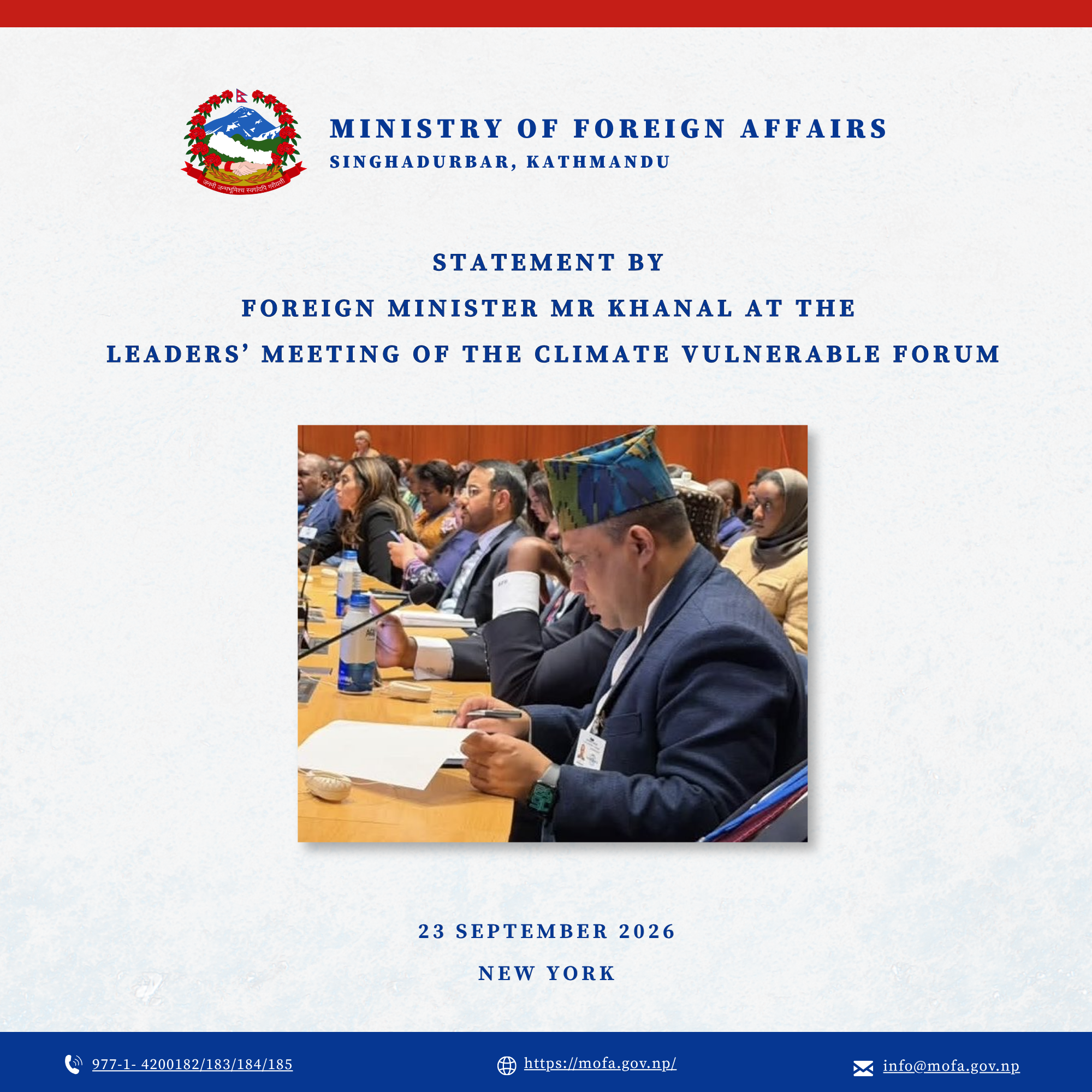
Statement by Foreign Minister Mr Khanal at the Leaders’ Meeting of the Climate Vulnerable Forum
Development Reset and Cooperation
The Honorable Mia Amor Mottley, CVF-V20 President and
Prime Minister of Barbados,
Honorable Ministers,
Excellencies.
It is an honor to address the Leaders’ Meeting of the Climate Vulnerable Forum. I commend Prime Minister Mia Mottley and the Presidency of Barbados for their tireless leadership and moral clarity in championing the cause of climate-vulnerable states on the world stage.
Excellencies,
What begins as accelerating glacial melt in the Himalayas cascades through our river systems and eventually contributes to the rising oceans that threaten low-lying island states like Barbados. Whether confronting a glacial lake outburst flood in the high valleys of Nepal or a category-five hurricane across the Caribbean, our peoples face the same fundamental crisis: frontline communities paying with their lives, homes, and developmental gains for emissions they did not generate. The cryosphere and the oceans form one continuum. This demands that mountain nations and Small Island Developing States forge an unbreakable alliance—collaborating shoulder-to-shoulder to demand global climate justice.
This solidarity is vital because climate change has severely derailed our pursuit of the 2030 Agenda. Globally, the Sustainable Development Goals are off track, with only 36 percent of targets showing moderate progress or better.
In Nepal, the climate crisis has become a structural brake on development. While Nepal has made noteworthy strides—raising our overall SDG Index score to 68.7 and reducing multidimensional poverty—our progress against long-term 2030 targets stands at just under 42 percent. Disasters continually reverse decades of hard-won socio-economic progress. The catastrophic transboundary floods, like a Tsunami in Himalayan Valley, of 26 August demonstrated how a single glacial collapse can wash away critical highways, wipe out clean hydropower plants, schools, hospitals, and destroy village livelihoods within minutes.
Instead of deploying our national budget into universal healthcare, quality schools, and digital transformation, we are forced to divert scarce resources into repeated post-disaster reconstruction. For frontline countries, climate change turns sustainable development into a continuous uphill scramble.
National ambition alone cannot resolve this global imbalance. Nepal remains steadfastly committed to nature-positive growth, our NDC 3.0, and our target of net-zero emissions by 2045. But we urgently require an international development reset across five strategic fronts:
First, Accelerating Climate-Resilient Development:
Every infrastructure investment—from transport corridors to community water systems—must be built to withstand climate risks. We welcome the operationalization of the Lifeline Fund to provide rapid liquidity when shocks trigger severe balance-of-payments pressures.
Second, Overhauling Development Finance:
A climate shock must never spiral into a debt crisis. Nepal strongly endorses the Bridgetown Initiative spearheaded by Prime Minister Mottley and the Vulnerability to Viability (V2V) Compact to unlock affordable, grant-based financing and scale up debt-pause clauses.
Third, Investing in Anticipatory Science and Early Warning:
We must expand impact-based early warning systems, real-time satellite telemetry, and cross-border data-sharing across the entire continuum—from high-altitude glaciers down to the seas.
Fourth, Driving Green and Digital Transitions:
We must accelerate an equitable transition away from fossil fuels. By expanding clean hydropower and regional grid links, Nepal is ready to serve as a green battery for regional decarbonization while creating digital economic opportunities for our youth.
Fifth, Delivering Genuine Loss and Damage:
The Loss and Damage Fund must be capitalized with new, addition-based grants—not repackaged commercial debt that extracts interest from tragedy.
A true development reset requires moving decisively from vulnerability to structural viability, from ad-hoc emergency charity to predictable development capital, and from isolated struggles to deep island-and-mountain cooperation.
Nepal stands ready to work hand-in-hand with Barbados and every member of the Climate Vulnerable Forum to amplify our collective voice and secure the shared future our peoples deserve.
Thank you. Namaste.
_MlbfVEdgFl_oaux7lg_YvvZnZKhlK_pq8f8ny.png.370x245_q70_crop.jpg
)