
Remarks by Hon. Mr Shisir Khanal Minister for Foreign Affairs of Nepal- Brand Nepal: National Assets, Global Narratives and Strategic Opportunities Project Report Dissemination and Policy Dialogue
5 November 2026 | Kathmandu
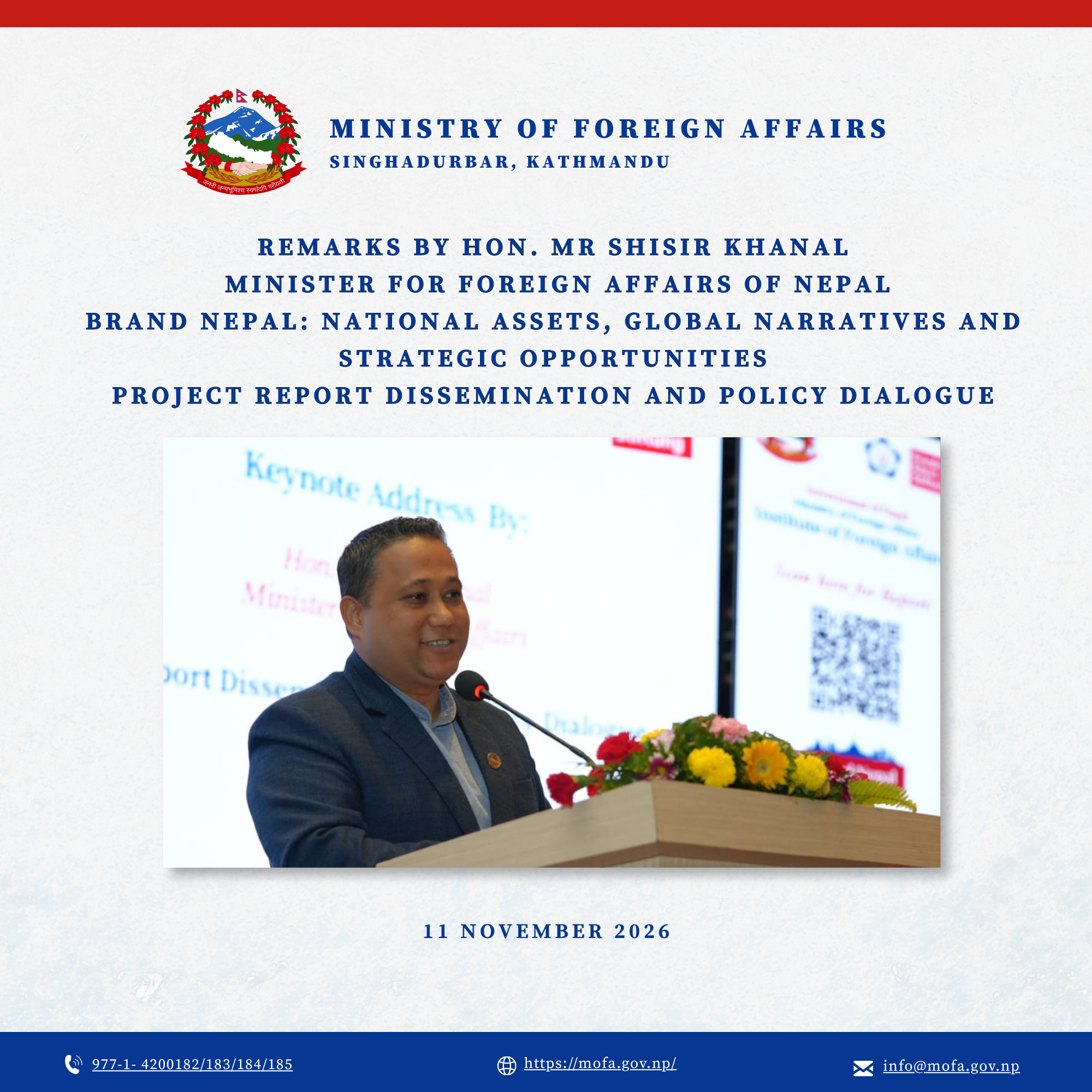
Remarks by Hon. Mr. Shisir Khanal
Minister for Foreign Affairs of Nepal
Brand Nepal: National Assets, Global Narratives and Strategic Opportunities
Project Report Dissemination and Policy Dialogue
5 November 2026 | Kathmandu
Distinguished Representatives of Friedrich-Ebert-Stiftung(FES) Nepal and the Institute of Foreign Affairs,
Excellencies,
Distinguished Scholars and Experts,
Representatives of the Private Sector, Civil Society and Media,
Ladies and Gentlemen,
Namaste and a very good afternoon!
It is my pleasure to join you for the dissemination of the project report, Brand Nepal: National Assets, Global Narratives and Strategic Opportunities.
I commend IFA and FES Nepal for this initiative and appreciate the scholars, practitioners, entrepreneurs, and community representatives whose deliberations in September informed this report.
Ladies and Gentlemen,
Nepal occupies a distinctive place in the global imagination. The Himalayas have inspired generations of explorers, Lumbini has drawn pilgrims from across the world, and our cultural heritage reflects centuries of artistic achievement and civilizational exchange.
These celebrated associations provide a strong foundation for Nepal’s global identity, enriched by the extraordinary diversity of knowledge, creativity, and traditions across our country.
From the intricate craftsmanship of the Kathmandu Valley to the weaving traditions of Himalayan communities; from Tharu artistic and ecological practices to the literary expressions of Maithili, Bhojpuri, and Awadhi-speaking communities; and from Kirat traditions in the eastern hills to the knowledge preserved across our mountains, hills, and plains, each contributes to our collective identity.
Nepal’s character is equally reflected in the enterprise of our communities, the creativity of our artists, the achievements of young innovators, and the contributions of Nepali professionals worldwide.
Together, these strengths offer a compelling foundation for a richer international narrative.
Our government is committed to rebranding how Nepal presents itself to the world, building upon our established identity while bringing contemporary achievements and emerging capabilities into sharper focus. We envision a Nepal confident in its heritage, dynamic in its outlook, and increasingly recognized for its contributions to global progress.
A nation’s reputation is a strategic asset, influencing investment decisions, diplomatic relationships, consumer confidence, and its standing internationally.
Brand Nepal is therefore integral to our development aspirations and foreign policy priorities. This report offers valuable insights for advancing that vision.
Allow me to highlight three priorities
First, we must recognize, protect, and enhance the value of Nepal’s diverse national assets.
Generations of artisanal excellence, agricultural innovation, and traditional knowledge have produced a remarkable national inheritance.
Our handwoven textiles, indigenous agricultural practices, traditional medicinal knowledge, regional cuisines, and artistic expressions carry immense cultural and economic potential.
Each represents a distinctive combination of place, knowledge, and identity. Appropriate intellectual-property protection, geographical indications, certification mechanisms, and quality standards can strengthen their international recognition and competitiveness.
Equally important is ensuring that producers and communities retain ownership and receive a fair share of the value they create.
We should aspire to a future where Made in Nepal commands global confidence through authenticity, quality, and responsible production.
Second, we must cultivate a broader and more compelling national narrative through public diplomacy.
Nepal possesses a wealth of achievements that deserve greater international visibility.
Our participation in United Nations peacekeeping reflects our commitment to international peace and security. Our community forestry experience demonstrates the value of participatory environmental governance. Our creative industries, emerging digital talent, and traditions of cultural coexistence offer further expressions of contemporary Nepal.
Public diplomacy allows us to communicate these strengths directly to international societies, institutions, and communities.
A nation’s image is shaped through countless interactions: a student’s experience at a university, a visitor’s encounter with local communities, or the professional contributions of its citizens abroad.
Within the Ministry of Foreign Affairs, our Public Diplomacy Division, together with our diplomatic missions, advances Nepal’s international outreach through cultural exchanges, academic partnerships, diaspora engagement, and strategic communication.
Initiatives such as the Sagarmatha Sambaad, convened in 2025 and scheduled again for 2027, demonstrate Nepal’s growing role in shaping global conversations. By facilitating dialogue on shared challenges, including climate change and sustainable development, we strengthen our standing as a constructive international partner.
The most persuasive public diplomacy will emerge when the narratives we communicate are reinforced by the experiences we create.
Third, we must connect our national identity with emerging strategic opportunities.
Nepal’s geography, ecological diversity, human capital, and diplomatic relationships offer significant prospects for economic advancement.
Our hydropower resources offer opportunities for regional energy cooperation. Our natural and cultural heritage can support diversified, higher-value tourism.
Our young professionals and entrepreneurs are connecting Nepal to international markets through digital services, innovation, and creative industries.
Our experience with mountain ecosystems and climate vulnerability also lends particular relevance to Nepal’s voice in global environmental diplomacy.
Realizing these opportunities demands strategic foresight, capable institutions, reliable infrastructure, and sustained partnerships.
The Ministry’s Economic Diplomacy Division, working alongside our diplomatic missions, connects Nepal’s strengths with foreign investment, markets, technology, and knowledge networks.
Our ambition is to position Nepal as a country recognized for its distinctive contributions, trusted partnerships, and expanding economic capabilities.
Ladies and Gentlemen,
Building a credible national brand requires concerted action across government and society.
Closer coordination among relevant ministries and institutions can help identify national assets, establish shared priorities, and align achievements in culture, trade, education, innovation, and environmental stewardship with our diplomatic engagement.
The private sector, academia, cultural organizations, local communities, and diaspora must be equally active partners.
I welcome the report’s emphasis on institutional responsibilities and practical recommendations. Our Ministry looks forward to examining its findings, particularly those relevant to public diplomacy, economic engagement, and Nepal’s strategic positioning.
I also encourage the IFA to sustain this momentum through research and policy dialogue.
Distinguished Guests,
A nation’s reputation is shaped by the achievements of its people, the credibility of its institutions, and the confidence it inspires internationally.
As we look towards the coming decade, let us envision a Nepal celebrated for its artistic excellence, entrepreneurial ingenuity, cultural richness, and the wisdom of its communities.
A Nepal whose diplomatic presence reflects its national achievements and whose international partnerships advance shared prosperity.
The foundations of this vision already exist. Our responsibility is to nurture them and connect them with the opportunities of a changing world.
I hope today’s dialogue will advance this collective endeavour with renewed clarity and purpose.
I congratulate IFA, FES Nepal, and all contributors to this initiative.
Thank you.
_VN77IhTIcX_xwx7cxo_xnvwLfuzaT_xbogasp.png.370x245_q70_crop.jpg
)